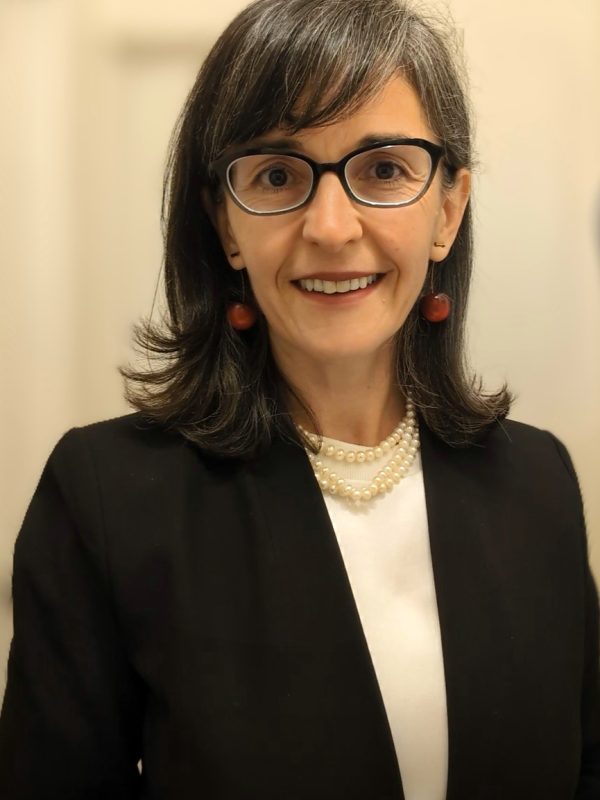
Stories of Strength:
Dr. Hermina Nedelescu
Making change happen
SAN DIEGO, California – Perpetrators who think women are easy prey have met their match. Dr. Hermina Nedelescu is a force to be reckoned with, and she’s on the warpath to bring accountability and healing to scores of women abused by clergy. Not only is she a victim-survivor herself, but she’s a towering intellect who studies the neurobiological control of abnormal behavior and the effects of trauma-induced stress adaptations and maladaptive behavioral responses.
And perhaps because of her natural curiosity and scientific focus, the ultimate goal is prevention and recovery rather than retribution.
“We’re doing this to safeguard people so they can have productive lives in a community,” Hermina says of her lawsuit, advocacy efforts and research. “We’re not trying to destroy the church or any other entity for that matter.”
Hermina’s story begins with her family’s flight from Romania, where the communist regime meant widespread suffering for most citizens. Long food lines for small rations, a constant moratorium on speaking about the country, and the need to hide books added up to a poverty of mind and body.
In addition, the family has maintained a longstanding commitment to the Orthodox Church over six generations, regularly attending liturgy, with several members serving as clergy. Now, Hermina sees that the church codified a kind of exploitation of female members. Girls were encouraged to wear skirts, would sometimes have to stay in a separate worship space, could not step onto the altar, and were forbidden from receiving the Eucharist when they were menstruating. In short, the church insisted that females were not worthy.
However, despite the endemic repression and exploitation, Hermina’s mother was a scientist, a clinical oncologist at Filantropia Hospital in Bucharest, which, while laying the groundwork for Hermina’s empowerment, also meant that the family had to flee the country.
In the US, like many refugees, Hermina’s parents got work that was related to their fields, but no longer held their same professional status. And the family found another Orthodox community, which was mostly Greek Orthodox rather than the Romanian tradition to which they were accustomed, but it still had the same context. In fact, Hermina says that she witnessed an even more exaggerated misogyny, which can be typical of a conservative trying to hold onto traditions or converts imagining what Orthodoxy in the mother country might be like.
And again, despite the constant pressure in the church to keep women in their place, Hermina and her family continued to pursue science, rigorous study and ever-growing achievements in their fields. Hermina studied biology at the University of California at Irvine and earned a Master’s degree in biology with a focus on neuroscience from New York University, where she studied how fear memories are encoded in the brain to support the onset of anxiety disorders. For her doctoral graduate studies, she was granted three prestigious fellowships: (1) a Marie Skłodowska-Curie Actions from the European Commission and (2) two Japan Society for the Promotion of Science (JSPS) fellowships from the Ministry of Education, Culture, Sports, Science and Technology (Monbukagakusho). As a result Hermina spent several years abroad, which gave her leeway as a foreigner in countries where women also were restricted.
Returning to the US, married and with an infant, Hermina took a post-doctoral position as a neuroscientist in 2016. After her son was born, she found she wanted to introduce him to her faith-based tradition. And so they started attending Saints Constantine and Helen Greek Orthodox church in San Diego, where the clergy befriended her family quickly.
To Hermina’s surprise, Father Michael Sitaras welcomed them warmly, despite knowing her husband is an atheist. The 70-year-old priest portrayed himself as very progressive, and told Hermina: “I am just a liberal priest.” When the pandemic hit, Father Michael Sitaras asked Hermina to be on a safety committee to help re-open the church.
“He pulled me into his orbit,” Hermina says. “It was a duty for me as a scientist to advocate for the safety of communities at a time when over 5,000 Americans were dying per day in the month of January of 2021. In addition, I had been using various viral vectors in my experimental work since 2013, giving me a clear understanding of their associated risks. What I had not realized at that time, is that Father Sitaras was grooming our family and those around me at the same time.”
Slowly and progressively, Father Sitaras started sexualizing their conversations, asking about her intimacy with her husband and escalating into prurient details that made Hermina increasingly uncomfortable. And yet, during this three-year period, he also entertained her ideas on how to advance the role of women in the church. Because Hermina is also pursuing theological studies at the Center for Theology and Natural Sciences at the Graduate Theological Union in Berkeley, she provided an amended protocol for liturgical participation that could help the church make a shift toward more inclusivity to include female participation in the liturgical life of the church. Father Sitaras allowed for a youth program where girls can participate, but he still would not permit them to enter the altar space.
Sitaras would isolate her by asking her to stay home from church to ensure compliance – especially on Sundays, when the congregation was larger – while encouraging her to attend weekday services, when only a few elderly congregants were present. Now, Hermina sees these behaviors as coercive control, proving how he could manipulate her despite her stated wishes. He would also call her frequently, and in the later stages asking for her schedule so he could exert more control. And he sent her an icon that he perversely defaced to depict the genitalia of Jesus and Jesus’ hands grabbing breasts, which Hermina now sees as foreshadowing his future actions.
“It’s a way to normalize and habituate to what he was proposing,” Hermina says. “In effect, because Christ had sexual relationships with women, you can have sex with me. In both Orthodox and Catholic theology, clergy are understood to reflect Christ on earth – in persona Christi in Catholicism, and through the bishop’s throne in Orthodoxy. This theological framework can be distorted and exploited. I later learned that this is a textbook tactic in clergy-perpetrated sexual abuse.”
It all came to a head on Aug 14th (her birthday) 2023. Sitaras called under the pretense of wishing her a “Happy Birthday.” Instead, he asked her more about sexual experiences with her husband, prying and shifting to suggest what he would do to her, effectively taking the place of her husband. She asked him emphatically to stop. And when she went abroad for a couple of trips, he insisted that he come see her upon her return on the pretense of dropping off a research paper from his seminary days, despite her asking him to send it to her electronically via email. Sitaras came to Hermina’s work, she scanned the paper for him, and then he sexually assaulted her, leaving her with permanent injuries.
“I was confused,” Hermina said. “He was a fatherly figure, and it was such a breach of trust. My body rejected him immediately, but that rejection wasn’t registering cognitively. It took me several days and the help of a therapist, for the first time in my life, for me to slowly figure out that I was a victim of sexual violence. Because of this experience I have vowed to help protect other victims.”
She filed a police report and a temporary restraining order as advised by the victim’s advocate coordinator in San Diego, and her husband complained to the church. But the church responded by retaliating against her. They removed her from a conference panel she had been invited to at a clergy-laity conference and defamed her, saying she “sleeps around with men in power” for all of her global travel. The Church Archdiocese sent an inoculating letter to the congregation saying: “there has been no determination that Father has violated the Misconduct Policy.” And while Hermina went to another parish for a year, she soon began to feel as if she were being complicit by going away quietly and thereby supporting an ecosystem of sexual violence.
“The church administration sent this email despite my husband’s complaint, which provided irrefutable evidence: the inappropriate icon Sitaras sent her, explicit messages from Sitaras, and obsessive phone calls documented in my call log,” says Hermina.
When Sitaras wasn’t arrested and wasn’t even removed from ministry, she saw legislative work as her only recourse.
“I have a duty to speak up because of all that I know and understand, because sexual abuse leads to sexual trauma with severe and permanent injuries,” Hermina says. “I’m already on theological boards with academics who are pushing the church forward to acknowledge that it has a problem with clergy-perpetrated sexual abuse; I helped rise an organization called Prosopon Healing to support survivors of clergy abuse within the Orthodox Church; I’m involved in global efforts to testify about sexual abuse and its negative impact on the brain and the nervous system.”
She became a fierce advocate of a new bill to combat clergy abuse, California AB 1739, which adds members of the clergy to California’s own list of barred professionals from having sexual contact with patients or clients. It’s a clever workaround to criminalize the ongoing behavior that churches condone by protecting priests from prosecution. In March, SNAP invited its community to advocate for the bill with dozens sending support letters to get the legislation passed.
It turns out that, according to Hermina, there’s a nefarious ecumenicism to sexual abuse. Whether the clergy in question is Orthodox, Catholic or any Christian denomination, research shows the patterns are the same.
“Catholics are at a new level of sophistication in fighting survivors,” Hermina says. “But Orthodox churches are still at the bottom with battle plans focused on retaliation and intimidation.”
With resilience and a formidable capacity to understand complex systems, Hermina is determined to make change happen regardless.
“My fight is with the church,” she says. “They did not know who they were dealing with.”
RESOURCES FOR HEALING, UNDERSTANDING AND ACTION
- For research-based help on recovering from clergy abuse, see Prosopon Healing, a resource site for Orthodox Christians.
- Hermina’s research on exclusion and the negative impact on the brain and the need for women to have a role HERE
- Hermina’s sermon on what forgiveness means and what it doesn’t mean HERE
- Walking meditation for anyone interested on SUBSTACK
- Hermina’s legislative efforts HERE