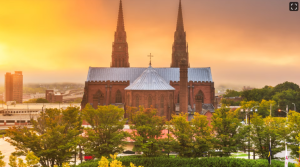
The Cathedral of the Immaculate Conception in Albany, New York. | Credit: Sean Pavone/Shutterstock
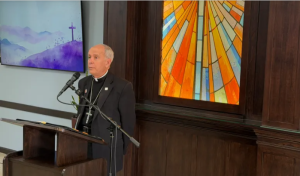
ALBANY, NY — The Diocese of Albany, New York, will pay survivors of sexual abuse a $148 million settlement in restitution for what Bishop Mark O’Connell called a “shameful chapter” of abuse in the diocese’s history.
The diocese announced the settlement in a press release on March 27. The nine-figure amount was still subject to court approval, but the amount itself had been accepted by the committee of survivors suing the diocese.
In the press release, O’Connell admitted a “clear and un-nuanced statement of guilt on the part of the diocese in its handling of our predator priests and others within the diocese.”
“It is a shameful chapter in our history, and no monetary settlement such as the one reached today will erase the pain caused to survivors,” he said while apologizing.
The bishop vowed to be “exceedingly diligent” in working to “prevent anything like this occurring again.”
Representatives of the survivors’ committee, meanwhile, said the settlement pointed the way to “closure for all survivors.”
The committee said it “looks forward to working further with the diocese to enhance its child protection protocols.”
The diocese in its statement said that diocesan insurers may contribute additional funds to the global settlement; the statement noted that it is “typical” for insurance carriers to provide “a significant portion” of abuse settlements.
The diocese had declared bankruptcy in 2023 while facing hundreds of abuse lawsuits under the state’s Child Victims Act of 2019.
In April 2025 then-Bishop Edward Scharfenberger announced that the Albany Diocese would launch a campaign to “rechannel [diocesan] efforts and resources” amid a major financial crisis.
The plan included the closure or merging of “perhaps one-third” of the diocese’s 126 parishes. The bishop said at the time that, among other things, “clergy health and well-being, quality sacramental ministry, consistent attendance, participation, and volunteerism” were “heading in the wrong direction.”
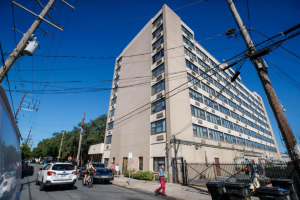
The $152 million deal, which closed Friday, includes 14 complexes housing about 1,600 elderly and disabled residents.
Tredway CEO Will Blodgett told NOLA.com that residents will be able to stay in the apartments.
The sale is a key part of the archdiocese’s bankruptcy settlement with hundreds of clergy sex abuse survivors. Under the agreement, proceeds from the sale will go toward a $300 million trust for survivors.
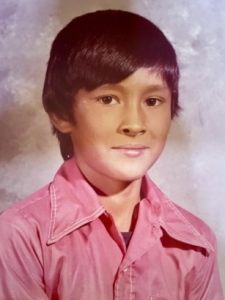
Clergy abuse survivor Isaac Melendrez Jr. at age 14
EL PASO, TX — El Paso Catholic Diocese officials confirmed more than 30 years ago that a priest sexually abused Isaac Melendrez Jr. and other boys, but never shared findings with him, or offered him help. Now, he’s speaking out.
In 1981, 14-year-old Isaac Melendrez Jr. was sexually abused by a man he now refers to as “a monster” – his parish priest in Doña Ana, New Mexico.
The boy told his mother, who didn’t take any action and later sent him on out-of-town trips with the priest. He said he told a Catholic Church official in Las Cruces in 1982, then never heard back. In 1985, El Paso’s bishop sent the priest to a California facility that diagnosed and treated clergy for sexual misconduct and other mental health disorders. In 1994, officials in the El Paso diocese interviewed Melendrez and other abuse victims and found that the priest’s actions were “consistent with the behaviors of a pedophile” – but never shared that finding with Melendrez.
He battled depression, anxiety and thoughts of suicide throughout his life. Now 59 and living in Las Cruces, Melendrez is angry and frustrated that the El Paso diocese is seeking bankruptcy protection in the wake of lawsuits filed in New Mexico by him and 17 others who were abused by priests as children.
“They basically get to throw a blanket over a mass group of people and our voices are squashed. We were never afforded, once again, that opportunity to have them defend or to tell the public why they did what they did,” Melendrez said in an interview with El Paso Matters. “They can issue all the statements on how terribly they feel about it now, how this ‘alleged’ abuse occurred, how this is in the interest of the victims. It’s not in the interest of the victims.”
The El Paso Catholic Diocese sought reorganization under the federal Bankruptcy Code on March 6, saying it was the best way to ensure that victims of clerical sex abuse are compensated while allowing the diocese to continue operating. El Paso is the 38th Catholic diocese or archdiocese in the country to seek bankruptcy protection as a result of lawsuits brought by victims of decades of sexual abuse by priests.
Melendrez said he is speaking out to ensure that the voices of victims are heard as the bankruptcy process moves forward. He is the only one among 18 clerical sexual abuse victims who’ve filed suit in Las Cruces to do so under his actual name. The others are named as John Doe or Jane Doe in their lawsuits to protect their privacy.
“If something wrong is done to you, you have the right to speak up and stand up for yourself,” he said.
“And I also felt very strongly that I’m not a John Doe, I’m not a Jane Doe, I’m Isaac Melendrez. What happened to me, number one, was no fault of mine. Number two, I had no control over it. And in order for me to feel that I was doing justice to myself and other victims, I felt like I needed to put a person behind the story, not just a pseudonym.”
In a statement to El Paso Matters, the El Paso diocese acknowledged the bankruptcy reorganization filing “has reopened memories of terrible wounds that have inflicted great suffering to all abuse survivors.”
The diocese didn’t respond to El Paso Matters’ questions about Melendrez’s abuse.
“We have turned our tragic past into a continued commitment to keep policies that prevent these abuses against the God-given dignity of the person from ever happening again,” Bishop Mark Seitz said in the statement. “My prayer is that, as this reorganization process moves forward, the church will have an opportunity to make amends and that we will be a place where survivors can find healing.”
The amount of damages to be paid to the 18 plaintiffs who sued the El Paso diocese in New Mexico will be determined by the federal Bankruptcy Court in El Paso. El Paso Bishop Mark Seitz said the diocese expects most of the money will come from insurance policies, but it also expects to have to use some of its own assets to compensate the plaintiffs.
The bankruptcy process doesn’t include extensive testimony from people with legal claims against the diocese. The amount of payments to individuals will be decided by a process overseen by an independent trustee.
A horrific betrayal of trust
About to turn 15 in August 1981, Melendrez was small for his age, weighing about 70 pounds, he recalled. His family lived in Doña Ana, a rural enclave near Las Cruces. At his parents’ urging, he volunteered to do groundskeeping work at their parish, Our Lady of Purification Catholic Church.
A new priest, the Rev. Richard Nesom Jr., had arrived at the parish in January of that year. A Mississippi native, he was ordained as a priest by the El Paso diocese two years earlier, shortly before his 40th birthday.
In a March 1979 investigation that was required for candidates for ordination, priests at El Paso’s St. Patrick Cathedral, where Nesom had been assigned as a deacon, said he was not a good candidate for the priesthood. Melendrez’s attorneys obtained Nesom’s employment records from the diocese as part of the lawsuit discovery process, and shared some of the records with El Paso Matters.
The Rev. Stephen Gotwals, who was then the pastor at St. Patrick Cathedral, said Nesom “seems proud and arrogant,” and “has sought money in ways which smack of a ‘con’ job.” Gotwals said: “I don’t feel he has the humility requisite for any priest.”
He said he reached those conclusions in consultation with other priests at St. Patrick Cathedral.
Gotwals acknowledged the investigation was “pro forma” because the then-bishop of El Paso, Patrick Flores, had already issued what are known as dimissorial letters clearing the way for ordination for Nesom and other priest candidates.
He said “we feel strongly that the ordination of Richard Nesom at this time with his attitudes would be a source of grief in the future for the diocese, for the people and, most probably, for himself.”
The Rev. Joseph Alexander, rector of St. Mark’s Seminary in Kentucky, where Nesom prepared for the priesthood, pushed back on Gotwals’ findings and suggested in April 1979 that Nesom be initially assigned to a “small parish” to test his sincerity about being a priest. In 2002, Alexander was removed from the ministry after acknowledging that he had sexually abused a teenage boy at the seminary 40 years earlier.
Nesom was ordained by Flores in August 1979 and was assigned to a parish in Monahans, a West Texas town of 8,000, before being assigned to Our Lady of Purification in January 1981.
One day, which Melendrez estimates was in July 1981, Father Nesom invited him into the rectory – the priest’s home at the parish. This is how the lawsuit describes what happened next:
“Fr. Nesom initially made small talk and then suddenly swooped down and accosted Plaintiff. Fr. Nesom, who was considerably larger than Plaintiff, put his hand down Plaintiff’s pants, grabbed Plaintiff’s penis, and kissed Plaintiff. Plaintiff hit Fr. Nesom on the chin/throat area with his fist. Fr. Nesom recoiled. Plaintiff warned him that if he ever touched him again, Plaintiff would kill him.”
“I ran home, and I told my mom right away, and that’s the role you take as a child in your household,” Melendrez told El Paso Matters. “And I assumed that something would come of it, perhaps maybe there would be some type of conversation with the priest.”
His mother did nothing.
“And that had a profound effect on me,” he said.
Melendrez’s lawsuit says that Nesom provided money and a car to his parents.
The parents are both deceased. Melendrez said he wasn’t close to his father, and never was able to talk to his mother about what happened to him after he initially told her.
“My mother unfortunately had this ability to just sweep things under the rug, per se, so it was not a topic that we had much conversation, if any conversation, moving forward in my life,” he said.
After the sexual abuse, Melendrez’s parents sent him on a trip to Mississippi and Louisiana with Nesom, according to the lawsuit. In Mississippi, Melendrez said he barred his door with a chair to protect himself from the priest.
The priest continued to pursue Melendrez with innuendos and advances, he said. Nesom bought him tennis shoes and would sometimes show up at Court Junior High School in Las Cruces and offer the boy a ride home, which he refused.
When Nesom was transferred to Marfa, Texas, later in 1981, Melendrez’s parents had him and his brother help the priest move.
“This man made my life a living hell for the eight or nine months he was assigned to our parish. … I was mocked at school. He told other altar boys I was gay. He used the derogatory term for it that we don’t use nowadays, called me fag,” Melendrez said.
After a few years in Marfa, Nesom moved to El Paso around 1986, and was assigned to St. Joseph Parish and St. Patrick Cathedral. He took out advertisements in El Paso and Albuquerque newspapers in the 1980s promoting tours of Europe and the Holy Land under his “spiritual direction.”
He appears to have left El Paso in the spring of 1989, according to newspaper archives reviewed by El Paso Matters, and returned to his native southern Mississippi by 1991. Newspaper archives from that region show him performing funeral rites until the spring of 1994; a 1998 article in the Hattiesburg American described him as “a priest on disability.”
Nesom died in 2002 at age 63.
Informing the church
Melendrez said he first told a church official about the abuse in the summer of 1982, about a year after it started.
He was spending a couple of weeks with his aunt, who lived near the offices of the new Las Cruces diocese, which was created earlier that year by Pope John Paul II. Las Cruces and other parts of southern New Mexico had been in the El Paso diocese before that.
“I garnered the strength one day, and said I was going to walk in there and I was going to tell somebody what had happened to me,” Melendrez said. He had not yet turned 16.
“I remember that a lady came out and grabbed a yellow note pad and jotted down some of what I said. And I asked her what she can do, should we take it to higher ups and then kind of see where it went. I assumed that maybe something would be done, that I might be contacted, something of it, and nothing ever came of it.”
Melendrez said he felt betrayed.
“I felt like everything that had ever been given to me had been turned on me, and I was by myself having to defend myself against this predator,” he said.
Melendrez now owns a construction company in Las Cruces. He and his wife, Olivia, were married in 1986, and have two daughters and a son. He has battled mental health issues that he attributes to Nesom’s sexual abuse.
“It’s been a very, very stressful life. It’s been very filled with a lot of anxiety, a lot of depression. I’ve been suicidal at times. I was an alcoholic at one time,” he said. “There was no recourse for what I was going through – the era, the ethnicity of what I am. A Hispanic man is supposed to be machismo and stuff just kind of stays in you.”
‘Consistent with the actions of a pedophile’
In 1994, the El Paso Catholic Diocese reached out to Melendrez.
“I was contacted by the diocese because another victim had come forward and shared their story and mentioned that they believed that I was also a victim,” he said.
After the diocese contacted him, Melendrez told his wife for the first time that he was a survivor of sexual abuse. He was interviewed by two diocese social workers on Oct. 13, 1994, according to records obtained by his attorneys and provided to El Paso Matters.
El Paso Matters isn’t identifying the social workers, who continue to practice in El Paso, because they can’t respond to questions about confidential interviews.
“They were very businesslike. They had a lady and gentleman in there. They listened to my story, but they kept wanting me to sign some papers, and they kept wanting me to accept their offer of counseling and they promised that they could make this go away if I would just sign these papers and then follow their path of guidance and counseling,” Melendrez recalled in his interview with El Paso Matters.
“They were both very adamant about it, and I refused. And I said, ‘No, I’m not signing anything. You’re not going to magically make this just go away.’”
The 1994 investigation focused on another man who said he was raped by Nesom when he was a boy and Nesom was the priest at Our Lady of Purification Church. As with Melendrez, Nesom’s first attack on the boy occurred in the parish rectory, according to the Letter of Determination from the diocese investigation that outlined its findings.
The man told the social workers that Nesom sexually abused him at least one other time at a hotel in Las Cruces.
The social workers interviewed Melendrez and another man who said he’d been sexually abused as a child by Nesom at Our Lady of Purification.
They also interviewed Nesom, then a priest in Mississippi, at the diocese Pastoral Center.
Nesom denied everything. The social workers said in their report that the priest told them that then-Bishop Raymundo Peña had told him “that anonymous calls had been received accusing (Nesom) of other incidents of sexual misconduct.”
The report doesn’t include any mention of Peña being questioned as part of the investigation. He was El Paso’s bishop from 1980 to 1995, when he became bishop of Brownsville. He retired in 2009 and died in 2021.
The social workers believed the victims. Nesom’s actions – including providing gifts to teenage boys and taking them on out-of-town trips – “raise questions as to Fr. Nesom’s motives,” their report said.
The rape victim’s “description of Fr. Nesom’s actions was very credible and consistent with the actions of a pedophile, as currently described in the literature,” the social workers wrote.
The report recommended that the diocese pay $19,000 for mental health care for the rape victim, who had filed a claim with the diocese. The payment could increase to $35,000 if the man needed in-patient treatment.
The report makes no mention of helping Melendrez and the other sexual abuse victim interviewed as part of the investigation.
Melendrez said the diocese never informed him about the findings of the 1994 investigation. He learned about it only after he filed his lawsuit in 2024, and his attorneys obtained records as part of the discovery process.
He said the October 1994 interview lasted between 90 minutes and two hours. Melendrez said he never felt the social workers were concerned about him.
“I think their interest was more in trying to stop anything, stop anything further” damaging to the church, he said.
‘Never be allowed access to children’
The report was clear on recommendations for Nesom’s future.
“We recommend that in the event that Fr. Nesom remains a priest, he never be allowed access to children, adolescents or young adult males.”
Nesom was stripped of his faculties in the El Paso diocese, or ability to exercise his duties of ministries, after the investigation, Nesom said in a 1996 letter to the Rev. John Peters, then the pastor of St. Luke Catholic Church in West El Paso. The letter was obtained by Melendrez’s attorneys, who provided it to El Paso Matters.
It’s not clear what impact the El Paso determination had in Mississippi’s Biloxi diocese, where Nesom went after leaving El Paso. But there are no mentions of him performing church functions in southern Mississippi newspaper archives after April 1994, at a time when priests were routinely listed in newspaper announcements as participants at weddings and funerals.
In a January 1999 letter to the Rev. Rick Matty, then the chancellor for the El Paso diocese, Nesom sought help in getting permission from then-El Paso Bishop Armando Ochoa to perform a baptism for his nephew’s child in Mississippi. He said Ochoa hadn’t responded to him.
“With the permission of the Bishop in this Diocese (in Mississippi), would this one event be permitted?” he asked.
Melendrez’s attorneys did not receive a record of Matty responding in discovery material provided by the El Paso diocese.
Other documents show that Nesom was barred from performing Masses or sacraments in public, but asked several times for permission to do so.
In one 1999 letter, responding to a note in which Nesom said he was performing a monthly Spanish Mass in Mississippi, Matty reminded him that he could only celebrate Mass privately, and not with other people.
Both the 1994 diocese investigation report and Nesom’s letter to Matty say that Bishop Peña sent Nesom in 1985 to the House of Affirmation, a Catholic facility in California that treated priests for mental health issues, including sexual disorders.
Nesom told Matty he was sent for “testing and evaluation as to pedophia,” misspelling pedophilia. He told diocese social workers and Matty that nothing negative was found, but no records of his evaluation have been provided by the El Paso diocese.
Other documents obtained by Melendrez’s attorneys and shared with El Paso Matters show that Peña sent Nesom to the California facility after another boy said the priest had sexually abused him in 1984 in Marfa.
Peña determined that the Marfa boy’s complaints weren’t credible, in part because the diocese wasn’t aware of any similar complaints against Nesom. However, Melendrez said he told the Las Cruces diocese in 1982 that he had been sexually abused by Nesom.
The House of Affirmation, a network of Catholic treatment facilities, was founded by the Rev. Thomas A. Kane, a priest in Worcester, Massachusetts. The facilities closed in 1990 after Kane was accused of financial improprieties.
The Worcester diocese later settled a lawsuit that accused Kane of sexually abusing a boy from 1968 to 1979, starting when the boy was 9. The lawsuit said Kane offered the boy for sex to other priests.
In the letter to Matty, Nesom – then 59 – said his health was poor.
“I have some difficulties; more attributable to diabetes than to HIV. I am still AIDS free. I don’t get around well and do not leave my little apartment,” Nesom wrote.
In a 1997 memo to the Catholic Diocese of Jackson, Mississippi, Father Michael Flannery said Nesom “is in denial that he has AIDS.” He also said Nesom had been involved in an incident in Florida where he walked out of a restaurant without paying his bill, then drove over the manager who followed him into the parking lot.
Documents provided to Melendrez’s attorneys show that the El Paso diocese continued $850 monthly payments to Nesom for the remainder of his life.
Nesom died Nov. 25, 2002. His tombstone in Sharon, Mississippi, reads: “Rev. Richard Nesom Jr. Catholic Priest.”
‘There’s no more calling it alleged’
Melendrez would like to see the Catholic institutions that failed him held accountable. It’s hard for him to define what that looks like.
“It’s changed 100 times now, because our justice system is not a perfectly written essay. Our justice system is very flawed,” he said.
It may be easier for him to define what accountability is not – what he sees as half-hearted admissions, or evasions of responsibility.
Melendrez’s path to the courthouse began in 2019, with a statement from the interim bishop of the Las Cruces diocese.
Like other U.S. dioceses, Las Cruces had published a list of priests found to be “credibly accused” of sexual abuse. Las Cruces updated its list a few months later to add 13 priests who served in southern New Mexico parishes and had been listed by other dioceses as credibly accused of abuse.
“These priests did not abuse here while they were serving in the Diocese of Las Cruces,” interim Bishop Gerald Kicanas said in announcing the 13 additions. “However, they have been listed on the credible lists of other dioceses.”
That didn’t look like accepting accountability to Melendrez.
Technically, Nesom sexually abused Melendrez and other Our Lady of Purification boys when the parish was in its last months in the El Paso diocese. But Kicanas’ diocese office was a 15-minute drive from Nesom’s former parish. And Melendrez said he had alerted the Las Cruces diocese to the abuse in 1982, without result.
Melendrez said he reached out after Kicanas’ statement to Margarita Martinez, the victims’ assistance coordinator at the Las Cruces diocese. He said he wanted a retraction of the statement, which sounded to him like the diocese was saying Nesom “wasn’t our problem, that was somebody else’s problem.”
He met with Kicanas, the former bishop of the Tucson diocese, a few weeks later.
“There was never any interest in our conversation with him doing any of that. He wanted to just talk about healing, and that he was sorry to me, and wanted to pray with me. And I lost my cool, and I just said, ‘You know, this is ridiculous. You people are not going to ever help us victims,’” Melendrez said.
The Las Cruces diocese didn’t respond to questions from El Paso Matters regarding its interactions with Melendrez.
The Las Cruces diocese is among the defendants in Melendrez’s lawsuit. The New Mexico lawsuits have been put on hold as a result of the El Paso diocese bankruptcy reorganization.
When the El Paso diocese announced its bankruptcy reorganization plans March 6, its news release referred to “allegations” of sexual abuse in the lawsuits brought by Melendrez and 17 others. In a video message issued to explain the bankruptcy filing, El Paso Bishop Seitz referred to “18 claimants alleging that they were sexually abused as minors” and “allegations that some clergy” harmed children in their care.
To Melendrez, that sounded like the diocese was trying to cast doubt on his story, even though it had found that testimony from him and other victims of Nesom was credible.
“The word alleged needs to be taken away. There’s no more calling it alleged,” he said. “If they want to argue that this was alleged, then they should have let us go to court and in the court of law, I could have told my story, my alleged story. Then a jury could determine whether my story was alleged or that my story was fact.”
In a news conference about the bankruptcy filing March 6, Seitz said the lawsuits by 18 people describing sexual abuse by Catholic clergy “appear to be credible. We’re not questioning that reality.”
As part of the lawsuit process, Melendrez wrote a letter of demand to the defendants – the dioceses of El Paso and Las Cruces, and Our Lady of Purification. He asked his son, Isaac Anthony Melendrez, to review it before it was submitted.
They cried together for several minutes. “And he said to me, ‘I had no idea how this affected you, because you never told us. And we grew up thinking that your problems with your emotions and being so broken, depression, anxiety and suicide, were because you weren’t happy with us as children.’ And that hurt me,” the elder Melendrez recalled.
Melendrez said he didn’t want to burden his children with his pain as they were growing up.
“So they have suffered right by my side immensely in this. And they are a great support system in seeing me through this. And they worry about me, and they stand behind me. But they know the profound impact that this has had on me, and how much it’s changed the course of my life, and how painful it’s been, and it’ll be for the rest of my life.”
Diocese of Oakland still working on settlement terms with abuse survivors
OAKLAND, CA — The dueling settlement offers from the Roman Catholic Diocese of Oakland and the hundreds of East Bay parishioners who say they were raped and abused by its priests are still separated by at least $90 million — and possibly tens of millions more, court records show.
Disputes over amount, insurance liability amount could add $90 million or more to final payouts
The chasm shows the work that remains to resolve nearly 350 lawsuits from people who say they were molested as children by church leaders and ordered by their alleged abusers to keep quiet. It comes just weeks ahead of a trial that is among a handful being moved forward as tests, which could provide new clarity on the diocese’s potential liability.
A committee representing those abuse victims recently filed court papers demanding $314.1 million over the course of three and a half years from the diocese and a related corporation overseeing its schools.
That compares with an offer of $180 million from the diocese and that corporation, made in late February, court records show. The offer reflects a small concession from the church to the victims, who have asked for more money to be paid up front by the diocese, which had originally offered a five-year timeline.
The diocese’s proposed payout also includes an additional $44.3 million from its insurers, upping the diocese’s total offer to $224.3 million. However, the committee representing abuse victims has previously taken issue with any insurance money being a part of any settlement offer from the diocese, as any such payout negotiated separately with the insurance companies could be significantly more than what the diocese’s accord alone could offer.
Dan McNevin, a state treasurer with the Survivors Network of those Abused by Priests, called the church’s offer “way too low,” and suggested the diocese sell off more real estate to help fund a larger payout.
“The bishop of Oakland has been low-balling this the whole time,” McNevin said. “He’s got to be less greedy — sell the land and fund this thing. It’s not that hard.”
The diocese did not respond to a request for comment Thursday.
Money isn’t the only sticking point holding up a potential settlement with the Oakland diocese.
One key disagreement rests in creation of a compliance monitor position, which would work to ensure that the diocese is following policies aimed at keeping children safe, such as improved training, background checks, the creation of a compliance advisory board of volunteers to help oversee the reforms. The committee of abuse victims wants that compliance monitor in place for no less than 10 years, while the diocese wants any such term to be generally capped at five years.
The dueling proposals come about a month ahead of a so-called bellwether trial — essentially, a legal test case offering new insight into how victims’ claims could fare in court.
The case was among the 350 or so lawsuits that were effectively paused in May 2023, when the diocese filed for bankruptcy. Seeing the lagging progress of settlement talks between the diocese and the abuse victims, a federal bankruptcy judge allowed six of those cases to finally proceed to trial. The goal: Allow each side to gauge juries’ reactions, as a means to hasten settlement talks for the remaining cases.
The first such case is expected to open on April 13, when an Alameda County jury will hear claims about how Stephen Kiesle, a former priest, groomed and repeatedly sexually assaulted one parishioner while that person was 10 and 11 years old. The assaults were alleged to have happened in 1975 and 1976, according to the lawsuit, which was filed in late December 2019.
The case was expected to go to trial March 16, but a judge pushed it off to mid-April, allowing more time for each side to reach a last-minute accord.
Kiesle has faced numerous other abuse allegations.
The former priest pleaded no contest in 1978 to a misdemeanor charge of lewd conduct for tying up and sexually abusing two boys at Our Lady of the Rosary in Union City. Yet despite his conviction — and the three-year sentence of probation that followed — he remained a part of the church during the 1970s and 80s.
He asked to be removed as a priest in the early 1980s, and Oakland diocese leaders also sought to defrock him. However, then-Cardinal Joseph Ratzinger — who later became Pope Benedict XVI — delayed a decision on his removal in 1985, citing “the good of the Universal Church.”
Kiesle was finally defrocked in 1987. Even so, he continued to work with the church, according to earlier reports from this news organization.
In 2004, Kiesle was sentenced to six years in prison amid a new wave of molestation charges, this time related to the abuse of a child at his Truckee vacation home in 1995. After his release for a subsequent parole violation in 2010, Kiesle was forced to register as a sex offender and moved into the gated Contra Costa census-designated place of Rossmoor.
Kiesle is currently serving a six-year, eight-month prison sentence for vehicular manslaughter. Authorities say he jumped a curb while driving drunk in April 2022, killing a 64-year-old man who had been walking home with his wife from a trivia event.
McNevin voiced confidence this week that a verdict in Kiesle’s case could improve the abuse victims’ negotiation position. A sizeable verdict, he said, could prompt other victims to demand more money from the diocese, and ask “Why should I get less?”
“If they don’t bring an offer up, then I think they have to let this thing go to trial,” McNevin said. “At that point, all bets are off.”
Seventh Avenue Baptist Church in Oakland, whose parking lot was sold out from under its notice
OAKLAND, CA — Oakland, Alameda County prosecutors say a local woman secretly sold a church parking lot and funneled roughly $480,000 from the deal to herself, announcing criminal charges today. The case is raising fresh questions about how churches and other nonprofits keep track of the real estate they rely on for programs and revenue.
Prosecutors: Lot Sold Without Congregation’s OK
According to prosecutors, the property at the center of the case is the parking lot serving Seventh Avenue Baptist Church, and the disputed sale generated about $480,000 that the district attorney alleges was misappropriated from the congregation. Details in the charging documents, including the timeline of the alleged transfers, were reported by The Mercury News. The church’s address is listed as 1740 7th Avenue in Oakland, according to MapQuest.
Charges and Potential Legal Exposure
The allegations center on embezzlement and related theft counts. In California, embezzlement of property or funds over the statutory threshold is typically treated as grand theft and can be charged as either a misdemeanor or a felony. Potential penalties for grand-theft-level embezzlement can include jail or prison time, substantial fines and restitution, and prosecutors often ask courts to order repayment to victims. California law and legal analyses, including those from Shouse Law, outline how theft-by-embezzlement is charged and the range of punishments available.
How Deed and Title Scams Fit This Pattern
While the facts in this specific case remain allegations that must be proved in court, industry data show that schemes involving the sale or encumbrance of property without an owner’s knowledge are a growing risk for parcels that are not closely monitored. A 2025 Deed & Title Fraud Survey from the National Association of REALTORS® found many real estate professionals have encountered deed or title fraud in their markets, particularly involving vacant or lightly supervised parcels, a trend legal observers say leaves noncommercial property vulnerable.
Case Status and What Comes Next
The Alameda County District Attorney’s Office has filed charges, and the matter remains in the early stages of prosecution. Court dates and additional filings were not yet public at the time of reporting. Local prosecutors are pursuing criminal charges and may also seek restitution on behalf of the congregation, according to The Mercury News. For general information about the office handling the case, the Alameda County District Attorney’s contact page lists office locations and public-facing resources.
How Churches and Nonprofits Can Guard Property
Experts recommend that congregations and small nonprofits periodically audit property records, sign up for county recorder fraud-alert services they available, and consult an attorney or title company before signing or accepting any paperwork that affects ownership. Title insurance, routine checks of recorded documents, and clear internal bookkeeping controls can all reduce the odds that a theft or forged transfer goes unnoticed. For legal help or to report suspected fraud, victims are advised to contact local law enforcement or the Alameda County District Attorney’s Office. Consumer resources from the National Association of REALTORS® and county recorder offices outline additional steps owners can take to monitor title activity.
WASHINGTON, DC — When a child sexual abuse scandal breaks, the public response is predictable: shock, outrage, promises of reform. But in the months and years that follow, institutions often evade accountability. They lawyer up. Records stay hidden. Survivors who finally come forward are silenced by the legal system itself.
Powerful institutions — from churches and youth organizations to schools and hospitals — are using bankruptcy laws to escape punishment for ignoring or covering up child sexual abuse. The authors of these statutes never anticipated this kind of abuse of the system. Congress must update our bankruptcy laws to close this loophole.
Chapter 11 of the federal bankruptcy code was designed to help honest businesses that are unable to pay back their debts. It allows companies and other institutions to keep operating while they restructure their obligations and negotiate with creditors.
But to provide that stability, Chapter 11 gives organizations the ability to pause lawsuits and reshape legal proceedings. And unfortunately, many institutions responsible for child sexual abuse have learned how to weaponize these legal tools to shield themselves from responsibility.
When an organization files for Chapter 11 bankruptcy, it triggers an automatic stay that freezes all lawsuits, including civil suits filed by sexual abuse survivors. Most importantly, “discovery” — the legal process that forces organizations to turn over internal records, personnel files and other evidence that can reveal negligence or a cover-up — comes to a halt.
In court, survivors are treated not as victims in a public courtroom, but as creditors, forced to fill out claim forms while the institution negotiates privately with insurers and lawyers in closed-door mediation sessions.
And that’s only for the survivors who have already come forward. For many victims of child sexual abuse, disclosure takes decades. Yet bankruptcy judges often impose strict “bar dates” — filing deadlines that can permanently shut out those who aren’t yet ready or able to tell their stories. Research shows that most victims don’t disclose their experience with child sexual abuse until their 40s or 50s, long after those deadlines may have passed.
In court, survivors are treated not as victims in a public courtroom, but as creditors, forced to fill out claim forms while the institution negotiates privately with insurers and lawyers in closed-door mediation sessions.
And that’s only for the survivors who have already come forward. For many victims of child sexual abuse, disclosure takes decades. Yet bankruptcy judges often impose strict “bar dates” — filing deadlines that can permanently shut out those who aren’t yet ready or able to tell their stories. Research shows that most victims don’t disclose their experience with child sexual abuse until their 40s or 50s, long after those deadlines may have passed.
Fortunately, Congress can put a stop to this strategy. The law already recognizes that bankruptcy is not meant to erase accountability in certain instances. For example, people are not allowed to discharge debts arising from fraud, willful injury, child support or even unpaid taxes. By the same token, organizations should not be allowed to use bankruptcy law to evade accountability for child abuse.
Congress has already created other exceptions, like in asbestos cases, to ensure victims can seek compensation even many years after the initial harm occurred. Ending automatic stays in abuse cases, banning third-party releases and guaranteeing victims the right to be heard before any reorganization plan is approved would help prevent organizations from using bankruptcy to evade accountability for abuse.
We’ve seen what happens when we look away. From the Catholic Church to the Boy Scouts, bankruptcy has become a way to manage rather than confront liability for abuse. And when institutions don’t face pressure to change, the same failures are almost guaranteed to repeat themselves, with children paying the price.
But if institutions could no longer escape accountability through bankruptcy, the calculus would shift. Leaders would face a clear choice: invest in real oversight and prevention, respond swiftly and transparently when abuse occurs, or face real financial consequences.
Under our current bankruptcy system, the victims lose twice: first to the abuse itself, then to a legal system that treats them like entries on a balance sheet. We need to change that and build a system that makes it harder to hide abuse than to prevent it.
Teresa Huizar is CEO of Washington, D.C.-based National Children’s Alliance, the nation’s network of nearly 1,000 Children’s Advocacy Centers, providing justice and healing through services to child victims of abuse and their families.
El Paso Bishop Mark Seitz speaks at a news conference regarding the diocese’s decision to seek reorganization under Chapter 11 of the Bankruptcy Code. (Robert Moore/El Paso Matters)
The El Paso Catholic Diocese, faced with potential “astronomical” judgments in a dozen lawsuits alleging clergy sexual abuse, filed for bankruptcy reorganization Friday.
The 12 lawsuits involving 18 plaintiffs, filed between 2022 and 2025 in Las Cruces, allege sexual abuse by priests at a number of New Mexico parishes between 1956 and early 1982, when southern New Mexico was part of the El Paso diocese.
“First of all, let me say we don’t see it as a way to duck out of our responsibility,” El Paso Bishop Mark Seitz said in an interview with El Paso Matters. “It’s the only way, with the resources at hand, that we can begin to address this many claimants in an equitable way.”
A 59-year-old Las Cruces man who is one of the plaintiffs in the lawsuits said the El Paso diocese is using the bankruptcy process to evade accountability.
“Today, just like in the past, the diocese is only doing what is best for them. By filing for bankruptcy, they have removed the opportunity for us to hold them accountable for their failures in a court of law. Bankruptcy brings no justice to the victims, only blanket protection to the diocese,” Isaac Melendrez Jr. said in a statement to El Paso Matters.
Melendrez alleges in a 2024 lawsuit in Las Cruces that he was sexually abused beginning in 1981, when he was 15, by the Rev. Richard Nesom at Our Lady of Purification Catholic Church in Las Cruces. Nesom is on the El Paso diocese list of priests credibly accused of sexual abuse. He died in 2022.
The survivors of clerical sexual abuse who sued the El Paso diocese want accountability and transparency, said Levi Monagle, an Albuquerque attorney who is representing several of the New Mexico plaintiffs.
He said the diocese had informed the New Mexico plaintiffs of the possibility of the bankruptcy filing, which by law would pause the lawsuits.
“The diocese could have filed its petition anytime they wanted to, and it made a lot of sense for the folks involved in those cases to try to, for lack of a better word, extract concessions from the diocese as to what a bankruptcy would look like in advance of its filing,” Monagle said.
He declined to discuss the negotiations with the diocese, but he said the survivors he represents want the diocese to establish a public archive of documents related to decades of sexual abuse. The archdiocese of Santa Fe established such an archive in its bankruptcy reorganization that was approved in 2022.
Another attorney representing survivors, Wouter Zwart of Albuquerque, said the bankruptcy filing was “retraumatizing” for some. Melendrez is among his clients.
“And I think the bankruptcy filing feels like another delay tactic, even if there’s light at the end of the road of this process,” Zwart said, saying some pending diocesan bankruptcy reorganizations are in their third or fourth year.
The first hearing in the bankruptcy case will be at 11:30 a.m. Monday.
Bishop Douglas J. Lucia of Syracuse, N.Y., celebrates Mass at the Cathedral of the Immaculate Conception in Syracuse May 9, 2025. (OSV News photo/Chuck Wainwright, courtesy The Catholic Sun)
The Diocese of Syracuse, New York, has formally closed out its long-running bankruptcy, funding a victims’ trust with more than $176 million to settle claims.
The move concludes a “journey of reparation” begun in June 2020 to “provide compensation for the pain and mistreatment experienced by survivors/victims of sexual abuse at the hands of those entrusted with their care,” wrote Syracuse Bishop Douglas J. Lucia in a Feb. 25 letter to diocesan faithful.
He noted that Chief Judge Wendy Kinsella of the U.S. Bankruptcy Court for the Northern District of New York, had approved the final decree in the nearly six-year case that same day.
The bishop said the diocese had “conveyed its commitment” to the agreed-upon victim’s trust fund, with $76.1 million provided by insurance and $100 million from what he called “our ‘Catholic family’” — parishes ($45 million), the diocese itself ($50) through “a combination of investments and loans,” and other diocesan entities ($5 million). The monies will be awarded by an independent arbiter, he said.
411 claims brought forward under two lookback laws
The diocese faced 411 unique claims from abuse survivors brought under two New York lookback laws after the Child Victims Act and the Adult Survivors Act took effect in New York state.
Together, the two acts allowed claims of abuse to be filed regardless of any prior statute of limitations. The CVA accepted filings through April 15, 2021, and the Adult Survivor Act through Jan. 17, 2023.
He noted the plan relies on a channeling injunction, a legal mechanism under U.S. bankruptcy code that funnels claims to a trust established to make payouts to both current and, in particular, future claimants.
With claims against the diocese, parishes and other Catholic entities resolved through the victims’ trust, the channeling injunction ensures “a comprehensive and just response,” providing “a unified path toward reparation rather than individual legal actions,” said Bishop Lucia.
He added that the plan “formalizes our commitment to Safe Environment policies, ensuring our protection protocols remain rigorous and effective in preventing a repetition of the past.”
Bishop expresses sorrow for survivors and apologizes on behalf of local Church
Bishop Lucia admitted that “we did not foresee how long this journey would take.” He noted “the wait has been a significant burden for those who filed claims,” as well as “the heaviness this has placed on the hearts of the faithful who have been scarred by this chapter in our local Church.”
“Throughout this Chapter 11 process, I have met with survivors who courageously shared their stories and expressed the depth of their pain,” said Bishop Lucia. “As your Bishop, words cannot adequately express my feelings and sorrow regarding such heinous behavior, but I again offer my most heartfelt apology to those who have suffered such harm and for any past neglect in addressing it.”
He invited diocesan faithful, and “especially survivors of abuse and their families,” to a special Mass on April 26, known as “Blue Sunday,” a day of prayer for those affected by abuse, and part of the observance of National Child Abuse Prevention Month.
OSV News reached out to Jeff Anderson and Associates, which is representing a number of abuse survivors in the settlement with the Syracuse Diocese. A representative replied the firm declined to comment.
“Beyond doubt, my heart continues to break for the damage that abuse has inflicted on the Church and its members,” Bishop Lucia said. “To the survivors and their families, I express genuine sorrowfulness and a firm resolve to ensure that future generations do not experience this scourge.”
“The Catholic Church in the United States has made a ‘Promise to Protect’ and a ‘Pledge to Heal,’” he said, referencing the U.S. Conference of Catholic Bishops‘ norms on addressing clergy abuse. “As part of that Church, we must remain ever vigilant.”
The Roman Catholic Diocese of Camden, New Jersey, has reached a new agreement to contribute an additional $180 million to a compensation trust for survivors of clergy sexual abuse, marking what church officials describe as the final resolution of its long-running bankruptcy case.
The new funding comes after a Chapter 11 reorganization plan was approved in March 2024 that had already established an $87.5 million settlement pool for abuse claimants. The expanded agreement was negotiated with a committee representing more than 300 survivors and remains subject to approval by the U.S. Bankruptcy Court in New Jersey.
According to the diocese, the trust will be financed by a combination of diocesan assets, parish contributions and payments from several insurance carriers.
Camden Bishop Joseph A. Williams issued a public statement acknowledging the harm suffered by survivors and thanking them for coming forward. He described their willingness to speak out as an act of courage and expressed remorse on behalf of church leadership, calling the abuse a serious betrayal of trust.
Attorneys representing the official committee of tort claimants welcomed the agreement. Jeffrey D. Prol of Lowenstein Sandler LLP, counsel to the survivors’ committee, said the new settlement amount is significantly larger than the $26 million initially proposed when the diocese first filed its reorganization plan in 2021. He credited the survivors’ persistence over several years of negotiations and litigation.
The road to the agreement was marked by disputes with insurers. Before confirming the 2024 Chapter 11 plan, U.S. Bankruptcy Judge Jerrold N. Poslusny Jr. rejected earlier versions after insurance companies argued that their contractual rights were not adequately protected. At one point, the judge paused implementation of the plan to prevent actions that could undermine pending appeals.
In 2025, both the diocese and the survivors’ committee sought to lift the automatic stay in the bankruptcy case, arguing that ongoing appeals were delaying compensation. They noted that mediation efforts with insurers had repeatedly failed. Insurers opposed lifting the stay, asserting that the court lacked authority over matters under appeal and that ending the pause would not meaningfully advance settlement talks.
Despite those earlier standoffs, negotiations eventually resumed, culminating in the newly announced $180 million agreement.
John Collins, chair of the survivors’ committee, said the settlement represents meaningful accountability, even though financial compensation cannot erase the trauma endured. He emphasized that the committee’s priority throughout the bankruptcy process was to ensure that survivors’ interests remained central to the proceedings.
The bankruptcy case, originally filed in October 2020, was brought under Chapter 11 in the U.S. Bankruptcy Court for the District of New Jersey. The diocese sought court protection as it faced hundreds of abuse claims following changes in state law that expanded the time period for filing lawsuits.
If approved, the revised trust structure would bring total compensation funding to well over a quarter of a billion dollars, significantly increasing the resources available to survivors.
The court’s review of the updated settlement is expected to determine the next steps in finalizing distributions to claimants.
The Franciscan Friars of California announced a bankruptcy filing in 2024 ‘to address 94 child sexual abuse claims.’
The Franciscan Friars of California have announced a $20 million settlement with alleged abuse victims, with the eight-figure payout coming after the group filed for bankruptcy several years ago.
The friars announced in 2024 that they had filed a Chapter 11 petition “to address 94 child sexual abuse claims.”
The order said at the time that the dozens of claims came about due to California state laws that “allowed abuse survivors to file decades-old complaints that were otherwise time-barred or expired under the state’s statute of limitations.”
In a Feb. 4 filing, the friars said they had agreed to deposit $20 million into a trust for alleged victims of abuse. In a press release, the law firm of Lowenstein Sandler — which has represented the abuse victims in the case — said the settlement is “the culmination of over 13 months of mediation among roughly 15 parties.”
The California friars are “the first California-based religious entity to have filed for bankruptcy after the California statute of limitations was revived … to announce a settlement between the debtor and survivors of sexual abuse,” the law firm said.
Most accused friars deceased; abuse occurred decades ago
The friars when announcing the bankruptcy said that all of the alleged abuse at issue in the settlement “occurred at least 27 years ago,” with some dating back to the 1940s.
“Almost all of” the claims were filed in California, and “most of the friars named in the claims” are deceased.
“Of the six living friars, all have been long-removed permanently from all public ministry and ministerial environments and are living under strict third-party supervision,” the friars said at the time.
The Chapter 11 filing was “the only viable path to ensuring just, equitable, and compassionate compensation for all abuse survivors,” Father David Gaa, OFM, said in 2024.
“A process supervised by the bankruptcy court can resolve a multitude of claims efficiently, in a timely manner, and with equity,” the priest added.
The Feb. 4 filing says that the friars will retain ownership of multiple real estate holdings, including the Gibson Mine, a historic copper ore site the Franciscans received as a donation in 1969. The friars engaged in an extensive environmental remediation effort at the mine in the early 2000s.