
Stories of Strength:
Sam Young
A question of persistence
HOUSTON, Texas – What kind of lines do you need to cross in order to get excommunicated? Turns out it depends on your church, and how they define “transgressions.” As people of faith, no matter what church you’re in, you’d hope that forcing a person out would be reserved for the most extreme cases, where damage to the community would outweigh the profound damage done to the individual forever banned from practicing a faith that promises eternal salvation. These questions never occurred to one Houston small business owner when he found out about the harm being done to Mormon youth during what’s known as “worthiness” interviews.
Sam Young learned that bishops had been asking inappropriate questions of young members as they sat alone and uncertain in private offices across the country. For Sam, who himself had served as a bishop for five years, the very idea of pressing a child on matters of sexuality was anathema. So, when his adult daughter told him the kinds of things their bishop had asked her when she was just 12, he was thunderstruck.
“The thought never came into my mind to ask a little 12-year-old some of the things they had asked her,” Sam said. “Yet it has come to the mind of countless bishops in countless places. It’s wrong and it has to stop.”
That seemed like a reasonable position to take–the only position if you want to protect children, Sam thought. But when he brought the idea of making a change to the interviews forward to his local leaders and stake president– who were his friends– they rejected it outright, saying “This is the way it’s supposed to be.”
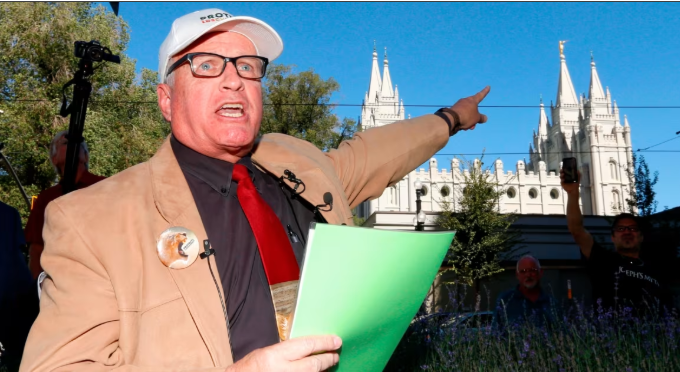
Sam had a lifetime of experience in the Mormon church, having been raised in a small town in Utah. He and his siblings attended church with their parents, following faithfully and going through all the milestones. Sam was baptised at 8, received the priesthood at 12, went on a mission for two years to Guatemala and El Salvador, then attended Brigham Young University where he earned a degree in chemical engineering. After he moved to Houston, he found a new Mormon community, met his wife and got married in the temple.
As he raised his family in the Mormon tradition, he served in many capacities: leading the regional young men’s program, serving on the High Council for two or three stints, being a congregational and regional leader in many capacities and in charge of missionary work. Sam also became a bishop, which is a local volunteer position that offers no training but asks an enormous amount of each individual. As bishop, Sam dedicated countless hours to the running of the congregation, not only conducting worship meetings every Sunday, but also youth meetings, home meetings to help members with challenges in their lives and the worthiness meetings that he now realizes could be fraught with peril for the teens and youngsters who were subject to them at regular intervals.
These worthiness meetings were meant to determine whether an individual has conducted themselves according to the church’s teachings, thereby proving their “worthiness” to attend temple services and advance in the priesthood.
“As a bishop you have very little training, certainly not pastoral training,” said Sam. “But you’re supposed to ask worthiness questions such as, Are you honest? Do you pay your tithing? Do you live the law of chastity? But there’s no specification on what or how much you should ask.”
But in March 2017 Sam found out what was really happening when he asked a man he’d known for 10 years why he’d stopped attending church. The answer was that when this man’s son became a teenager, during worthiness interviews their bishop asked him if he masturbated and had sex with other boys. When his son told him what happened, this big and imposing man leaned over the desk and threatened the bishop, and then chose not to go back to church.
Horrified, Sam asked people on Facebook if they’d had similar experiences and was flooded with stories. That’s when one of his daughters told him that she was asked the same things when she was 12. Since she didn’t even know what masturbation was, she googled it and then found porngraphy.
“I was angry and saddened that this had happened to my child,” Sam said. “I still get emotional about it. Especially when she turned around and said to me, ‘Dad, Mom, I thought you guys knew what they asked youth behind closed doors.’”

So, now that his friends had rejected his attempts at reform, Sam tried to reach out to Salt Lake to let them know his concerns. He received no response after several attempts.
“Every single day that I don’t get a response, another kid is going to be harmed,” Sam said. “This is going to last for years if not decades. They may be groomed by a bishop for sexual abuse. How many is enough before we act? One hundred or a thousand?”
What happened next is where Sam stepped into advanced awareness-raising tactics. Sam started a petition in August of 2017 and got 60,000 signatures from Mormon parents, who wanted to see change happen. Parents began insisting that their children not be alone in the room with the bishop during those interviews. And people began reporting their own stories in the comments section.
“They’ve never seen anything like it, having someone stand up to say what happened to you was wrong, and it wasn’t your fault validated them,” Sam says. “This was big for them, towards their healing.”
That’s when the New York Times called and asked how they could read the stories. So, Sam started a website to document people’s experiences, Protect LDS Children – Stop Sexually Explicit Interviews of Mormon Youth in December of 2017. Now there are over 1,000 stories listed, with mental health complications ranging from intense shame and a perverse sense of responsibility for their abuse, to attempts of self-castration, suicidal ideation and attempted suicide.
But despite all the attention, the church policy remained unchanged. So Sam and others organized a march to put pressure on the church. He gathered all the stories collected so far and published them in 15 books, addressed to each of the 15 Mormon apostles.
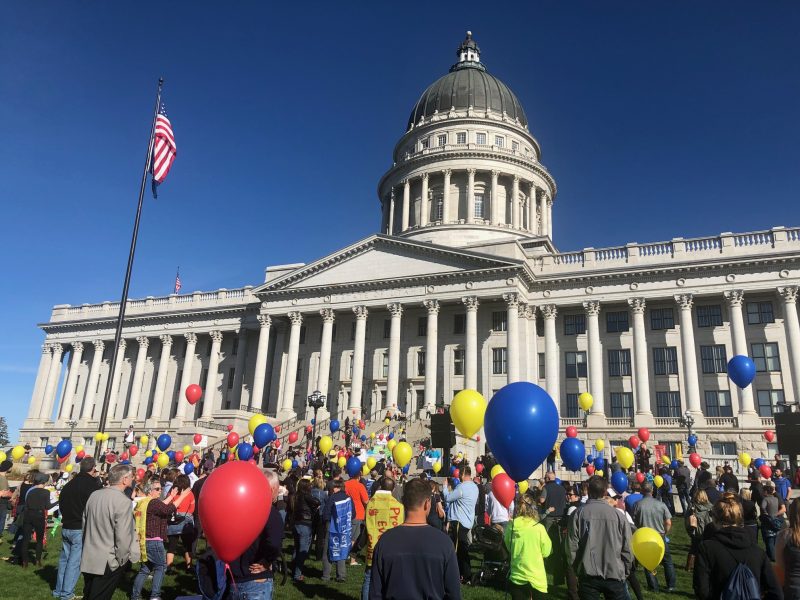
On March 31 2018, they held a rally with speakers and then marched to the church office building to present their “evidence” of harm. And this time, their efforts paid off. The church changed its policy to allow a second person in the room for the interviews–if the child requests it. Newspapers across the country and the globe responded with a flurry of coverage. However, the issue of explicit questions wasn’t even addressed, which to Sam’s mind was insufficient. The church just cautioned bishops against excess in their questioning.
“There’s no definition on what ‘excess’ means,” Sam said. “And it was just gross the things they’d ask. It was dirty and they should never have been asked.”
So, Sam rallied to come up with another tactic. He patterned his efforts to gain attention after Mahatma Ghandi, who fasted as a form of protest. Sam enacted a 23-day fast across the street from the temple in Salt Lake. Every day, he live-streamed on Facebook, covering a different topic, and talked to people as they passed by. This event gained 500,000 views and was covered extensively by local and national media.
“I would have continued to fast, but my wife was concerned about my health,” Sam said.
This is a man determined to bring a spotlight to his cause. In fact, Sam spent a year and half on trying to drive much-needed change and a huge amount of his retirement money as well. His business was suffering due to his inattention, and he thought to himself that he’d done enough. In fact, his efforts did help many kids avoid being alone with a bishop in a trying interview, as well as many more find validation for the harm they’d experienced.
But the cause was not done with him. Sam got called into disciplinary court when he returned home and the Mormon church revoked all his ordinances, excommunicating him from a faith community that he’d served his entire life. Not only that, Sam was told he’d be damned to outer darkness, the Mormon term for what’s known as hell.
“You are entitled to your opinion or position,” the edict said. “But you cannot remain a member in good standing while attacking the Church and its leaders and trying to get others to follow you.”
While the Mormon church position is that bishops hold a sacred responsibility to lead, teach, and inspire youth, their use of personal interviews and the sexually explicit questions asked in that private space were at odds with their aims. If the interviews were meant to help youth become disciples of the Savior, repent of transgressions, and live the gospel of Jesus Christ, then surely there was room for adjustment.
And in fact, the edict given to Sam did address the crux of the problem, as they saw it.
“The issue is not that you have concerns – or even that you disagree with the Church’s guidelines, rather it is your persistent, aggressive effort to persuade others to your point of view by repeatedly and deliberately attacking and publicly opposing the Church and its leaders,” the church’s excommunication edict says.
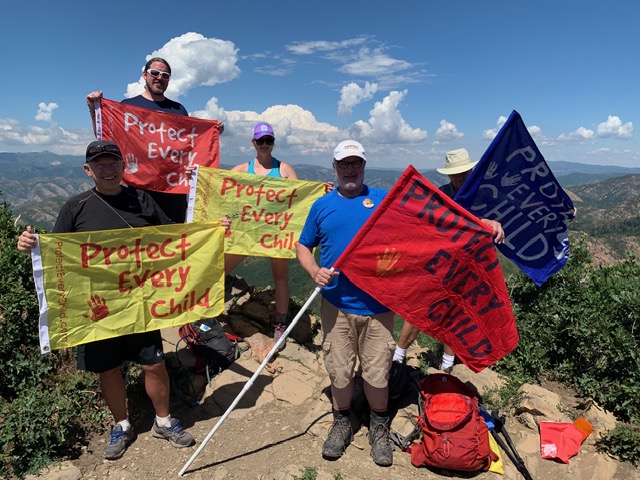
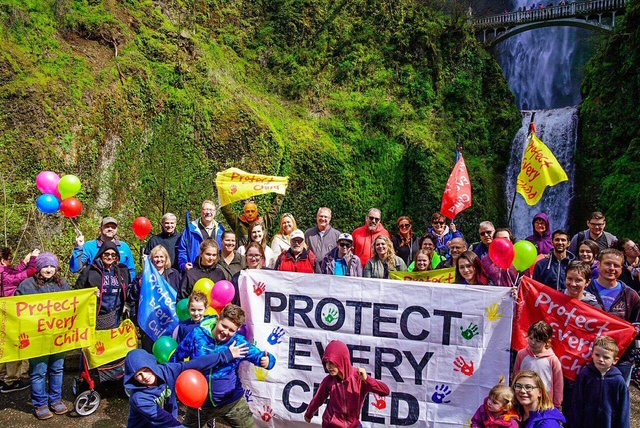
In response, Sam broadened his effort and launched another initiative called “Protect Every Child” in 2019. At 67 years old, he wanted to make sure all children, not just those in the LDS community, were aware of the problems inherent in explicit sexual interviews. He created banners with the motto and urged his followers on Facebook to take the banners and climb to a hilltop somewhere and share photos of them holding the banners aloft. To Sam, raising awareness of the potential harms to children far outweighed his church’s unwillingness to be criticized and/or forced into change.
Still undaunted, he insists that a simple 10-word demand is not too much to ask for: “No one-on-one interviews. No sexually explicit questions, ever.”
But other commitments called and he returned to the business he’d neglected, with 35 employees who depended on him. He was still needed to keep the wheels moving on that endeavor too. The company managed to make it through the pandemic, fortunately, and Sam was able to sell it a few years later and fully retire himself.
Recently, an old friend of his from the Mormon community sent Sam a letter that said, “You were ahead of your time. Most of your changes have been implemented.”
And Sam is ok with that. Three of his daughters are still active members of the church and he supports them in their activities. He is regularly invited to his grandchildren’s events, baptisms, etc. and he attends happily. He says his daughters don’t think he’s going to hell and support what he did to protect kids.
“In a lot of places, the culture has changed,” Sam says. “As far as the church, it’s still wide open, but I’m encouraged that the culture has changed. It’s discouraging that the church hasn’t changed as far as I’d like it to be. But I think good things are happening, and we’ll keep going forward.”
RESOURCES
- To read or report stories of Mormon youth who have experienced clergy misconduct or abuse, see Protect LDS Children – Stop Sexually Explicit Interviews of Mormon Youth
- For a broader outreach, see ProtectEveryChild.com, a resource site for sexual abuse survivors of any religion.